

New York Public Library: Positioning AI Enhanced Search
Enhanced search is an AI-powered research tool launching on NYPL's website, giving people anywhere in the world free, instant access to all scholarly books in their collections. Through a client engagement, I helped develop its positioning strategy: a digital newsletter that introduces the tool in a familiar, nostalgic format. The result helps NYPL introduce technological change while staying true to its mission of lifelong learning and access to knowledge.
CONTEXT
4-week client engagement · Parsons School of Design · Speculative strategy, prototyped
TEAM
3 Designers
YEAR
2026
INDUSTRY
Culture, Arts, and Education
TECH STACK
Figma
Claud (research)
ChatGPT (mockup generation)
Miro
MY ROLE
CREATIVE STRATEGY
POSITIONING STRATEGY
RESEARCH & INSIGHTS
CLIENT COMMUNICATION
DECK DESIGN & PRESENTATION

The Challenge
For 130 years, NYPL has mediated between information, infrastructure, and the public, building its brand as a steward of knowledge and lifelong learning. Integrating AI poses risks to its brand and credibility, especially amid public concerns for privacy, accuracy, gaps in AI literacy, and devaluing of human expertise. How NYPL positions Enhanced Search will shape brand perception, trust, and the digital library experience, and will also serve as a roadmap for other cultural institutions in AI integration, demonstrating what responsible, public-serving technology looks like. It will act not just as a participant in technological change, but as a critical voice in shaping its direction.
Project Brief: How might we position the AI-powered Enhanced Search in a way that preserves the trust the NYPL has spent 130 years building?
The Strategy
Through our strategic discovery, we understood that Enhanced Search should be introduced not as a technology launch but as a natural extension of the Library's mission — a new way into the collections. Our strategy balances a gradual rollout, plain language, and a familiar visual identity, so trust is earned at every touchpoint.
The Solution
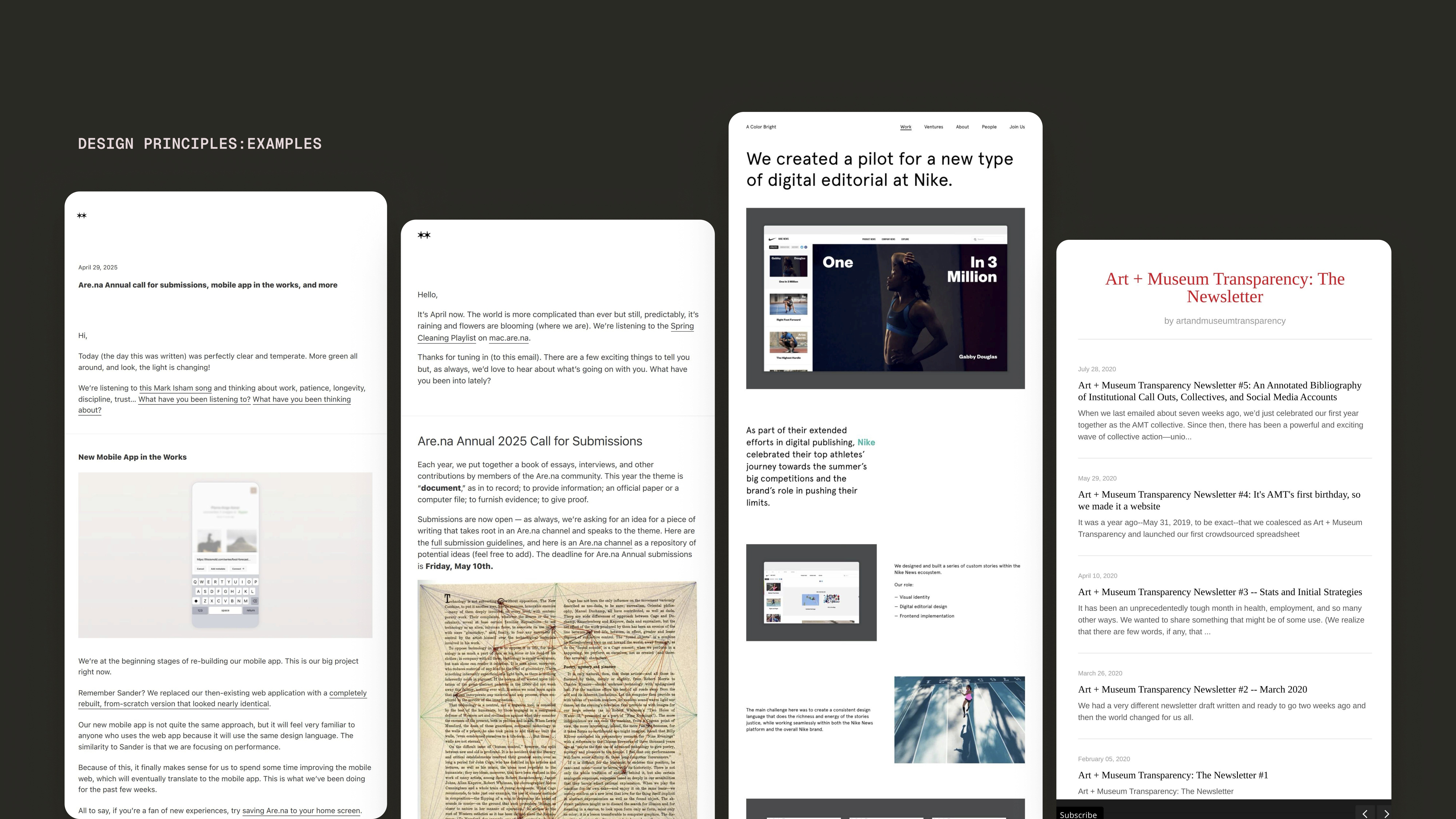
Our solution is centered around reviving a simpler time on the internet: a six-month, opt-in newsletter series from the NYPL that gradually introduces Enhanced Search to existing patrons. Written in a plain, first-hand voice without buzzwords or hype, and designed in a simple, spacious style with NYPL's visual identity, each issue explains how the tool works and what material it makes accessible.
RESEARCH METHODS
Exploration
Client discovery, stakeholder mapping, audience segmentation, review of product features and existing brand materials, research on public perceptions of AI and similar rollouts
Validation & Iteration
Presented insights and concepts to client and iterated based on feedback
6+
hours spent meeting with clients at NYPL
INSIGHTS
Trust is earned gradually. Concerns about privacy, accuracy, and AI literacy mean people need time and context, not a launch moment.
Public perception of Al in 2026 is shaped by certain associations: hallucinated facts, buzzwords and jargon, black-box systems, data harvested without consent, automation that displaces human judgment.
The Library's existing cultural capital is a valuable asset to build on. Its visual identity, editorial voice, and archival collections are already trusted, so the introduction could draw from what already signals public trust, credibility, and institutional confidence.

WHY A DIGITAL NEWSLETTER?
PACE AND TIMING
Each issue can introduce one idea, one design decision, one example of what the tool makes accessible — researchers can build understanding across installments the way they might across sources
REPLICATES NYPL'S OLDEST VALUE
The Library operates on a principle of open access by choice and curiosity — an opt-in newsletter extends this into the digital space, where subscribers are treated like patrons rather than segmented targets in a marketing funnel
IN THE LIBRARY'S OWN FORMS
NYPL communicates through catalogs, finding aids, exhibition notes, and reading lists — forms that are informative, authored, and unhurried. A newsletter reflects this, recalling a slower, simpler time on the internet to introduce a technology associated with speed and automation.
ACCUMULATION INTO THE ARCHIVE
Centered around the preservation and accessibility of knowledge, NYPL introduces this tool through a form that produces its own referenced, searchable record. Over time, the newsletter becomes a document of institutional reasoning that can be read by later subscribers, covered by publications, or cited by institutions considering similar projects.
AUDIENCE
PRIMARY
Existing NYPL newsletter subscribers, particularly Research at NYPL and NYPL Connect
SECONDARY
New subscribers who opt-in through NYPL's website and social channels
Sample opt-in framing: "We're building something new and writing about it as we go. Sign up if you're interested."
TERTIARY
Publications, writers, researchers, and organizations in the library, cultural, design, and technology worlds who may discuss and circulate NYPL's approach through their own channels
EDITORIAL VOICE
AN INSIDER LENS
Written from an insider's perspective, grounded in firsthand knowledge and curatorial intent
PLAIN AND PRECISE
Plain where clarity serves the reader and precise where the subject requires it — free of abstraction and black boxes
NO BUZZWORDS OR HYPE
No jargon or enthusiasm in place of evidence — informative over promotional language
VISUAL DIRECTION
SIMPLE AND SPACIOUS
Density signals urgency and disorder; spaciousness lets the material speak for itself
FAMILIAR BY DESIGN
Aligns with NYPL's visual identity, which already signifies longevity, credibility, institutional confidence, and public
ARCHIVAL MATERIAL
Includes content from NYPL's collections so every image in the newsletter shows what the tool makes accessible
CONTENT ARCHITECTURE
ISSUE 01: INTRODUCTION
Key message: We're building something with great potential, and we want to bring you along with us
ISSUE 02: WHAT THE ARCHIVES HOLD
Key message: There is an extraordinary amount of material here. Until now, finding what you needed required knowing what you were looking for
ISSUE 03: HOW THE TOOL WORKS
Key message: This tool can only point you to things that exist in our collection
ISSUE 04: BUILT ON THE MISSION
Key message: The library has always been a bridge between people and knowledge
ISSUE 05: RESEARCHER WALKTHROUGH
Key message: Here's what the tool looks like in practice
ISSUE 06: WHO THIS IS FOR
Key message: You don't need to be a scholar to use this. You just need a question
ISSUE 07: GUARDRAILS/LIMITATIONS
Key Message: Each constraint is a deliberate design decision around what Al should and shouldn't do in a library context
ISSUE 04: OUR COMMITMENTS
Key message: Why we believe in introducing Enhanced Search — free access, open inquiry, institutional neutrality, and respect for the patron's autonomy. We took this seriously because you trust us, and we intend to keep earning that.
PUBLISHING TIMELINE

Outcomes
We presented the research and concept in person to the NYPL team, to FMP's founder, who responded enthusiastically to the strategy. As a speculative project, it remains a proposal offering a research-backed model for introducing Enhanced Search in a way that builds trust.